





Your calls answered by leading travel experts in under 5 seconds.

Unpublished offers and great discounts when you book on-call.

Hand-crafted travel itinerary that meet all your travel preferences.

Round-the-clock customer service to get all your doubts clarified.
When you plan a vacation to a destination and want to book your Czech Airlines flight tickets, then reach out to My Flight Fares. Our travel experts guide you through the booking process and help you score great airfares in your desired budget. We have flight offers from our inventory of 450+ airline options. Starting from Economy, First and Business Class tickets, My Flight Fares travel experts can give you various other services on your Czech Airlines bookings like extra luggage, priority check-in, in-flight meals, and more.
Yes — Czech Airlines (CSA) allows seat selection. You can choose your seat during booking, later in “Manage Booking,” or during online check-in (about 36 hours before departure), and most standard seats can be selected for free, while some preferred seats (like extra legroom or exit rows) may require a small fee.
A PNR (Passenger Name Record) is your flight’s unique 6-character booking reference code that stores all your trip details like passenger name, flight itinerary, seat, and ticket status, and you use it to check in online, manage your booking, or access your boarding pass on the airline’s website or app.
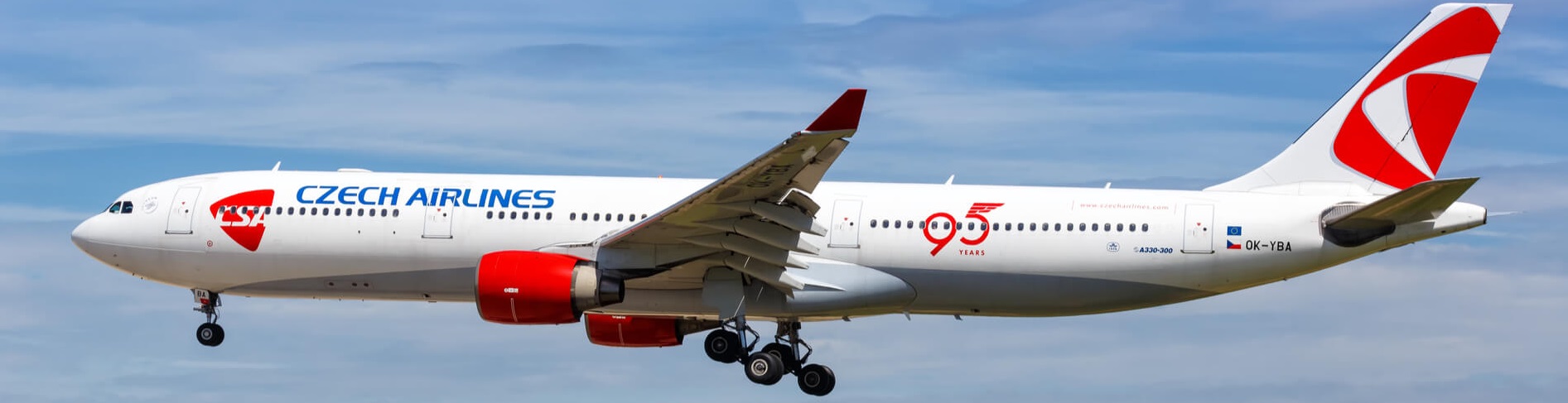
Yes — Czech Airlines (CSA) technically still exists, but only as a brand/holding company, not as an operating airline. It stopped flying its own scheduled passenger flights on 26 October 2024, with operations transferred to Smartwings, so there are no more flights under its old “OK” airline code; however, the brand and company structure still remain and may be used for future business or ownership changes.
Yes — you can check your flight booking online by going to your airline’s website or app, selecting “Manage Booking” or “My Trips,” and entering your booking reference (PNR) plus your last name to see your flight details, status, seat, and check-in options; if your booking doesn’t appear, it may still be processing or booked through a travel agency, so you may need to wait or contact them directly.
You can contact Czech Airlines (ČSA) through their official customer service phone line at +1-855-551-1040 (available daily, usually 8:00–20:00) or by emailing [email protected]; they also provide help through the “Contact Us” form on their website, which is often used for refunds, booking changes, and complaints, and you can also reach them via airport service desks if your issue is urgent.
You can check if a ticket is confirmed by logging into the airline’s website or app with your booking reference (PNR) and last name, where a confirmed ticket will show full flight details, seat (if assigned), and status as “confirmed” or “ticketed”; you can also verify through your confirmation email or by contacting the airline or travel agent if the booking doesn’t appear online.
For Czech Airlines (ČSA), the typical Economy Class allowance is 1 carry-on bag up to 8 kg (about 55 × 45 × 25 cm) plus 1 checked bag up to 23 kg (total dimensions up to 158 cm) on most standard fares, while cheaper “Lite” fares may not include checked baggage at all and Business Class usually allows 2 checked bags up to 32 kg each, with exact rules depending on your ticket type and route.
There won’t be a direct “replacement” airline for Czech Airlines (ČSA), because it already stopped operating as an airline in 2024 and its flights were absorbed into Smartwings, which now handles most of its routes under its own branding; the long-term plan is that Smartwings continues operating in Europe, and there is also a potential future change where Pegasus Airlines is moving to acquire Smartwings (and the former ČSA structure) pending approval, which could reshape who runs those routes, but there is no single new flag carrier replacing ČSA as an independent airline.
Czech Airlines (ČSA) was based in Prague, with its main operations centered at Václav Havel Airport Prague, which served as its primary hub for all domestic and international flights before it stopped operating scheduled passenger services in 2024.
On Czech Airlines flights, meals depend on your ticket and route: in Economy, FLEX fares usually include a free light snack (like a sandwich, biscuit, and water), while LITE and PLUS fares typically don’t include free meals but offer paid onboard food or pre-order “Gourmet Menu” meals with hot and cold options (like pasta, sandwiches, or Czech-style dishes) plus drinks; Business Class gets full complimentary multi-course meals on longer flights.
You can contact an airline through its official website or mobile app (Contact Us or Manage Booking section), customer service phone line, email or web form, and sometimes airport service desks for urgent issues, with phone support being fastest for changes or cancellations and online forms better for refunds or complaints.
Czech Airlines (ČSA) is now owned by the Smartwings Group, which is the main Czech private aviation company; the airline itself stopped operating flights in 2024 and was converted into a holding/brand structure under Smartwings, while ownership is also currently involved in a pending deal where Turkey’s Pegasus Airlines has agreed to acquire Smartwings and the ČSA structure (subject to approval).
Czech Airlines (ČSA) stopped operating as an airline on 26 October 2024, when it officially ceased its last flights and merged operations into Smartwings; after that date, it no longer ran its own passenger services and instead became a holding/brand structure under its parent group.
There is still a Czech airline industry, but there is no longer an active national flag carrier called Czech Airlines (ČSA) as it stopped operating flights in 2024; today, the main Czech-based airline is Smartwings, which runs most scheduled and charter flights from the Czech Republic and effectively serves as the country’s primary airline, even though it is privately owned rather than a state flag carrier.
You can contact the Czech Air Force through the official Czech Ministry of Defence, since the Air Force is a branch of it, using their main website contact form, email addresses listed for public inquiries, or the ministry’s central phone line; for official or public requests, they direct communication through the Defence Ministry rather than a separate public Air Force hotline.
The largest airline in the Czech Republic is Smartwings, a Prague-based private carrier that operates most of the country’s scheduled and charter flights across Europe and holiday destinations, effectively making it the dominant Czech airline since Czech Airlines stopped operating its own flights in 2024.
Very unlikely — Czech Airlines (ČSA) is not expected to return as an independent airline. It officially stopped operating flights in October 2024 and was turned into a holding/brand under Smartwings, with all operations moved to Smartwings instead, and most recent plans (including a potential Pegasus acquisition of Smartwings) still keep the brand structure but do not include restarting ČSA as a separate flying airline.
No — the Czech Republic does not currently use the euro; its official currency is the Czech koruna (CZK), and while the country is an EU member, it has no fixed date to adopt the euro, though some shops in tourist areas may accept euros informally, change is usually given in koruna and exchange rates are not always favorable.
No — Czech Airlines (ČSA) is no longer operating as an airline. It officially stopped all scheduled passenger flights on 26 October 2024, when its last flight landed from Paris to Prague, and its operations were taken over by Smartwings, meaning it no longer flies under its own name or code, even though the brand still exists as part of a holding structure.
A “Czech airline” usually refers to an airline based in the Czech Republic, and today the main one is Smartwings, which operates most scheduled and charter flights from the country after Czech Airlines (ČSA) stopped flying in 2024; so while ČSA was historically the national flag carrier, Smartwings is now the largest active Czech-based airline serving Europe and holiday destinations.
Czech Airlines (ČSA) was acquired/controlled by the Smartwings Group, which became its parent company and took over its operations in the final restructuring phase; later, in late 2025–2026, Smartwings (including the former ČSA structure) agreed to be bought by Turkey’s Pegasus Airlines for about €154 million, but that deal is still subject to regulatory approval and not fully completed yet.
Many airlines fly to the Czech Republic, mainly to Václav Havel Airport Prague, including major European carriers like Lufthansa, Air France, KLM, British Airways, Ryanair, easyJet, Wizz Air, Turkish Airlines, and Austrian Airlines, plus holiday and regional airlines such as Smartwings, offering direct connections across Europe, the Middle East, and some long-haul routes.
You can check your flight booking by going to the airline or travel website, selecting “Manage Booking” or “My Trips,” and entering your booking reference (PNR) plus your last name to view your flight details, ticket status, and seat, or you can check the confirmation email/SMS you received after booking; if nothing shows up, contact the airline or travel agency with your payment details to verify it.
Czech Airlines (ČSA) stopped operating as an airline on 26 October 2024, when it flew its final flight from Paris to Prague and ceased all scheduled passenger services, ending over 100 years of operations and fully transferring its activities to Smartwings.
No — Czech Airlines is not flying anymore. It officially stopped all flights on 26 October 2024, when its last service operated from Paris to Prague, and since then all operations have been taken over by Smartwings, so there are no active Czech Airlines passenger flights under its own code or name today, even though the brand still exists on paper as part of a holding structure.
The Czech Republic has about 6–7 major international airports, but only a few handle regular passenger traffic: the main one is Václav Havel Airport Prague, followed by regional airports like Brno, Ostrava, Karlovy Vary, Pardubice, and others, though Prague Airport handles the vast majority of international flights and traffic in the country.
Czech Airlines (ČSA) was considered a safe airline with strong international compliance, holding IOSA certification (IATA’s global safety standard) and having no fatal accidents in its modern operating history, which is a key benchmark in aviation safety; independent evaluators like AirlineRatings previously rated it in the highest safety category (up to 7/7) based on audit compliance and incident-free operations, while Skytrax focuses more on service than safety and generally classifies it as a 3-Star airline for overall quality rather than safety performance.
Czech Airlines baggage policy (before it stopped operating flights in 2024) generally allowed Economy passengers 1 carry-on bag up to 8 kg (about 55 × 45 × 25 cm) plus sometimes a small personal item depending on fare, and 1 checked bag up to 23 kg with total size up to 158 cm on standard tickets, while Business Class allowed 2 checked bags up to 32 kg each; cheaper fares like “Lite” often had no free checked baggage and required paying extra, and oversized or overweight bags were charged separately.
For most airlines like Czech or Croatia Airlines, a standard checked bag in Economy is usually allowed up to 23 kg (about 50 lbs) per piece, while Business Class often allows up to 32 kg per bag, and exceeding these limits typically results in extra baggage fees or needing to split items into additional bags.
Czech Airlines (ČSA) was based in Prague, with its main hub at Václav Havel Airport Prague, which served as its primary airport for all domestic and international flights before it ceased operations in 2024.
No — Czech Airlines does not offer in-flight entertainment like seatback screens or Wi-Fi on most flights, especially short European routes; passengers typically only get a magazine or basic printed materials, and entertainment is limited to what you bring yourself (like downloaded movies or books), with some past or limited exceptions on certain aircraft or longer services.
The last flight of Czech Airlines (ČSA) was flight OK767 from Paris Charles de Gaulle to Prague Václav Havel Airport, which landed on 26 October 2024, marking the end of its 101 years of operations as an independent airline before its services were taken over by Smartwings.
Sitting on your hands during takeoff can help you stay calm and reduce anxiety or nervous movements, but it is not a safety requirement—airlines actually recommend that you keep your seatbelt fastened, seat upright, and hands free so you can brace or follow crew instructions if needed, so while some passengers do it for comfort, it’s generally better to keep a natural seated position rather than restricting your hands.
The airlines with the roomiest economy seats are usually Asian and Middle Eastern carriers, with **Japan Airlines, All Nippon Airways, and Emirates offering about 34 inches of seat pitch (best in the world), which is noticeably more legroom than the global average of 30–31 inches; other comfortable options include Cathay Pacific and Singapore Airlines (around 32 inches), while most U.S. and European airlines sit closer to 30–31 inches.
Yes — in most cases you can get a full refund if your flight is cancelled, especially under EU rules like EC 261, where the airline must offer you either a replacement flight or a full ticket refund within about 7 days, regardless of the reason for cancellation; however, if you choose to continue traveling on another flight, the refund may not apply since the airline has already rebooked you instead.
Yes — you can get a refund if you cancel a flight, but it depends on your ticket type: refundable fares let you cancel and get your money back (sometimes minus a small fee), while non-refundable tickets usually only give credit or no refund at all, except in cases like cancellations within a 24-hour grace period or special airline rules; always check your fare conditions before cancelling.
Yes — in many cases there is a cancellation fee, especially for non-refundable or cheaper economy tickets, and the fee can range from a small service charge to a large deduction from your refund or even the full ticket value; however, some airlines allow free cancellation within 24 hours of booking or for flexible/refundable fares where no penalty applies, so the exact fee depends on your ticket type and airline policy.
Yes — you can cancel a non-refundable flight ticket, but you usually won’t get cash back; instead, most airlines will either give you travel credit or a voucher minus cancellation fees, and in some cases (like cancelling within 24 hours of booking or under special circumstances such as illness or airline schedule changes) you may still get a partial or full refund depending on the airline’s policy.
The new ticket cancellation rules (2026 in India) mainly say that airlines must give passengers a 48-hour “look-in” window after booking, where you can cancel or change tickets without extra charges (only fare difference may apply), and they must also provide faster refunds (usually within 7–14 days depending on payment method) and clearer rules for cancellation charges, including limits and mandatory refunds of taxes and fees even on non-refundable tickets; after the 48 hours, normal airline-specific cancellation rules apply.
There isn’t a “best excuse” that guarantees a refund, but airlines are most likely to approve cancellations or waive fees for documented emergencies like serious illness, hospitalization, death in the family, or major airline schedule changes or cancellations, while personal reasons (like change of plans or budget issues) usually don’t qualify unless you have a flexible ticket; always check your fare rules and provide proof if you’re requesting a waiver.
You usually have 24 hours after booking to cancel a flight for a full refund if you booked directly with the airline and the departure is at least a few days away, and some regions like the EU also require refunds if the airline cancels or significantly changes your flight; after the 24-hour window, refund eligibility depends on your fare type, with refundable tickets allowing cancellations anytime (often with a fee) and non-refundable tickets usually only giving credit or no refund.
You usually have 24 hours after booking to cancel a flight for a full refund if you booked directly with the airline and the departure is at least a few days away, and some regions like the EU also require refunds if the airline cancels or significantly changes your flight; after the 24-hour window, refund eligibility depends on your fare type, with refundable tickets allowing cancellations anytime (often with a fee) and non-refundable tickets usually only giving credit or no refund.
The new flight cancellation rules (India, effective March 2026) say you get a 48-hour “look-in” window after booking where you can cancel or change your ticket without cancellation fees (only fare difference may apply), and after that airlines must still give faster refunds (usually within 7–14 days) and clearer, capped cancellation charges, while also ensuring taxes are refundable even on non-refundable tickets; if the airline cancels your flight, you are still entitled to a full refund or free rebooking.
Yes — fully refundable flight tickets are usually more expensive than non-refundable ones because you’re paying extra for flexibility and the ability to cancel for a full cash refund; in many cases they can cost 2–5 times more than the cheapest economy fare, since airlines price them higher to cover the risk of last-minute cancellations and to segment flexible business travelers from budget travelers.
In Economy Class on most international airlines, the standard checked baggage allowance is usually 1 bag up to 23 kg (about 50 lb), with some airlines or long-haul routes allowing 2 bags of 23 kg each, while budget airlines may include no free checked baggage at all and charge extra depending on your fare and destination.
Most airlines allow Economy passengers 1 checked bag up to about 23 kg (50 lb) and a carry-on bag around 7–10 kg plus a small personal item, while Business Class often allows 2 checked bags up to 32 kg each, but the exact allowance varies by airline, route, and ticket type, so it’s always best to check your specific booking rules.
If your carry-on is over the allowed weight (like 7–8 kg), the airline may ask you to repack items into your checked baggage or pay an excess fee, and in some cases they might require you to check the bag into the cargo hold at the gate, especially on strict airlines or full flights; enforcement varies, but heavier cabin bags are commonly flagged during check-in or boarding.
If an airline changes your schedule significantly, you usually have the right to accept the new flight, request a free rebooking on a different flight, or get a full refund, especially if the change is major (like many hours or a day difference or a missed connection); under rules like EU EC 261, you may also get compensation if the change is within the airline’s control and causes a long delay or disruption, but if it’s due to extraordinary events like weather, compensation may not apply.
Yes — airlines can change scheduled flights, including departure times, aircraft, or even cancel or reroute flights due to operational needs, weather, or demand; if the change is minor you’re usually just notified, but if it’s a significant change (like a major time shift or cancellation), you’re typically entitled to a free rebooking or a full refund depending on the airline rules and regulations like EU EC 261.
Yes — if your flight schedule changes significantly, you can usually get a full refund, especially if the change is major (like several hours, a different day, or a missed connection); under rules like EU EC 261, you also have the right to choose a free rebooking or a refund, and even if the change is small, some airlines still allow refunds depending on their policy and fare type.
Most airlines let you reschedule a flight anytime before departure, but changes usually have rules like needing to be made at least 2–24 hours before takeoff, depending on the airline and fare type; flexible or higher-fare tickets allow changes even on the same day, while cheaper economy tickets may require paying a change fee or fare difference and can have stricter deadlines.
Yes — Czech Airlines (ČSA) still exists, but not as an operating airline anymore. It stopped all flights on 26 October 2024, and its passenger operations were taken over by Smartwings, so there are no Czech Airlines flights today, only the brand and holding structure remain, with future ownership changes still being planned but no return to flying.
If your checked luggage is over 23 kg, most airlines treat it as overweight baggage, and you’ll usually have to pay an extra fee at the airport; typically bags between 23–32 kg are allowed but charged a “heavy bag fee,” while anything above 32 kg is often not accepted and must be repacked or shipped separately as cargo, and the exact cost depends on the airline and route but can range from about €50–€200+ per bag or more on long-haul flights
If you are entering the Czech Republic (EU) from a non-EU country, the duty-free allowance is usually 1 litre of spirits (over 22%) or 2 litres of lower-alcohol drinks, plus 4 litres of wine and 16 litres of beer, and for tobacco it’s about 200 cigarettes or equivalent amounts of cigars or tobacco, plus personal goods worth around €430 by air; if you are travelling within the EU, there are no strict duty-free limits for personal use, but customs may question large quantities.
You can select seats during booking on the airline’s website or app by choosing “Seat Selection” on the seat map before payment, or later through “Manage Booking” by entering your PNR and last name; if you don’t choose a seat early, you can usually select one during online check-in (24–48 hours before departure), though some cheap fares may charge a fee or assign a seat automatically if you don’t pick one.
Seat selection is not always free — it depends on the airline and your ticket: many airlines charge for choosing specific seats (especially window, aisle, or extra-legroom seats), while basic or standard seats may be free or only assigned for free at online check-in (usually 24–48 hours before departure); some fare types or loyalty members also get free seat selection, so in short, cheap tickets often charge for advance seat choice, but you can usually get a random seat for free at check-in.
There isn’t a single “worst airline to avoid” that applies to everyone, because safety standards are tightly regulated globally and even low-cost airlines are generally safe, but the ones passengers most often complain about tend to be ultra-low-cost carriers with lots of extra fees, strict baggage rules, and inconsistent service, such as Ryanair or Wizz Air in Europe or Frontier in the US, which score low on comfort and customer satisfaction rather than safety issues . More important than avoiding specific airlines is understanding that delays, hidden fees, and customer service quality vary more than safety, so the “best” choice depends on whether you prioritize price, comfort, or reliability rather than avoiding a specific airline entirely.
Czech Airlines left SkyTeam mainly because it stopped operating as a real airline. In 2024 it underwent restructuring where all its flights were transferred to its parent company Smartwings, and it no longer operated its own scheduled passenger or cargo services under the “OK” code, which is a core requirement for alliance membership; since SkyTeam membership is based on active flight operations, the alliance ended its membership on 26 October 2024 with mutual agreement and minimal network impact.
Yes — Czech Airlines (ČSA) did offer Business Class before it stopped operating flights in 2024. It included features like wider seats, lounge access, priority boarding, and better meals, especially on European and long-haul routes, but it is no longer available today because the airline has ceased operations and its flights were taken over by Smartwings.
If your baggage is lost, you should immediately report it at the airline’s baggage desk and file a Property Irregularity Report (PIR), then track it using your reference number; if the bag is not found after about 21 days, it is officially considered lost, and you can claim compensation from the airline under rules like the Montreal Convention, which usually covers up to around 1,300–1,600 EUR per passenger depending on proof of contents, by submitting receipts, baggage details, and the PIR to the airline’s claims department.